Bridging Technology and Communication: Building a Campaign for AI Literacy
When I began my Strategic Communication capstone at Washington State University, I wanted my work to do more than meet a requirement. I wanted it to connect my professional experience in technology with my belief in education as a force for equality and opportunity. Throughout my career, I’ve seen how rapidly technology transforms industries, but also how unevenly access and understanding can spread. This project became an opportunity to bridge that gap.
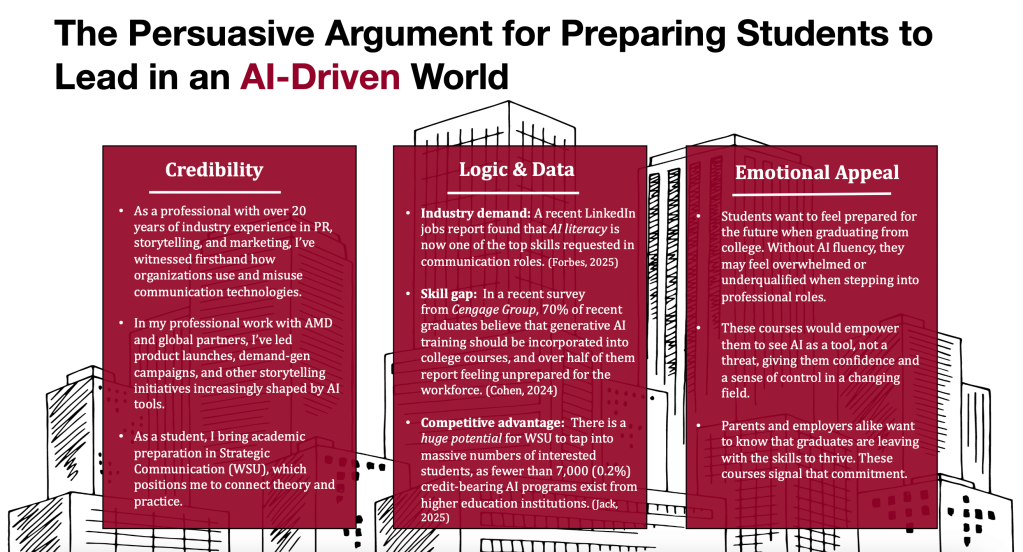
For our Persuasion Pitch assignment in COMSTRAT 701, I chose to create a campaign advocating for AI literacy in communication courses. The idea was rooted in a simple but powerful premise that education changes behavior when it both informs and motivates. My goal was to design a course concept that framed AI literacy not just as a technical competency, but as a life skill that integrates ethics, creativity, and opportunity.
Purpose and Planning
The assignment challenged us to demonstrate our ability to develop and present a persuasive business or project proposal. This required a clear definition of purpose, audience, and measurable outcomes, key elements of any strategic communication plan.
For my campaign, the purpose was twofold:
- To persuade communication faculty and administrators that AI literacy belongs in the curriculum, and
- To illustrate how such a course could prepare students for the evolving professional landscape shaped by generative AI.
Drawing on persuasion theory, I focused on the principles of authority, social proof, and reciprocity to build credibility and inspire collaboration rather than fear. The planning process involved outlining a message strategy, designing visual materials, and developing supporting research to establish both urgency and opportunity.
Framing the Message
Artificial intelligence is already transforming how we live, work, and learn, yet for many students (and the public in general), it remains abstract or intimidating. I wanted to change that narrative.
The campaign framed AI literacy as a human skill, not a machine one. GenAI is a tool for expression, problem-solving, and ethical decision-making. By highlighting examples from creative industries, journalism, and higher education, I showed how communication professionals could use GEnAI to enhance storytelling, accelerate workflows, and engage audiences responsibly.
This approach also positioned AI literacy as a democratizing force, aligning with the broader mission of public education, which is to prepare all students, regardless of background, to participate meaningfully in a technology-driven society.
Process and Creation
To bring this campaign to life, I followed a structured creative process similar to the research frameworks we have used previously.
- Research and Contextualization
I began by reviewing academic and industry sources on AI adoption in communication disciplines, including ethical frameworks for responsible use. - Audience Analysis
I defined key stakeholders—faculty, curriculum designers, and students—and crafted messages tailored to their values of innovation, relevance, and student success. - Message Design
The campaign deck emphasized empowerment rather than replacement. - Visual and Presentation Tools
I developed a short presentation deck and supporting visuals to simulate a real-world pitch. Each slide was designed to reinforce clarity, credibility, and motivation.
Lessons Learned
Developing this persuasion pitch reminded me that communication is as much about empathy as it is about logic. I learned that the most persuasive messages are not those that showcase complexity, but those that simplify it, making ideas relatable and actionable.
I also realized how essential framing and tone are when introducing new technologies. Fear-based narratives create resistance, while inclusive language invites participation. In designing this campaign, I aimed to make AI feel approachable with a set of tools that students could use creatively and critically, rather than view with apprehension.
Another key insight was the value of aligning personal experience with academic purpose. By drawing from my background in technology marketing, I could ground my argument in real-world application while translating that experience into a learning context that benefits others.
Reflection and Impact
Ultimately, this project reflects what drives me most: using communication to democratize access to knowledge. Artificial intelligence should not be a privilege for a select few; it must be a shared foundation that prepares every student to thrive in the future.
This experience reinforced the importance of merging theory with practice, of turning communication principles into actionable change. By blending my understanding of persuasion with my passion for technology and education, I created a campaign that not only fulfilled a course objective but also aligned with my professional mission: to make technology accessible, ethical, and empowering for all.
Thank you for your response. ✨

 Strategic Storytelling