Building Understanding Through Research
Creating an effective communication campaign requires more than creativity. It demands a deep understanding of audience perception, message framing, and behavioral intent. As part of our ComStrat 565 Professional Marketing Communication Management and Campaigns course, we were asked to create a marketing campaign, create a focus group to refine the message, and update the campaign. I developed an AI campaign focus group with teens aged 13-17 to explore how they interpret, emotionally respond to, and evaluate the use of generative artificial intelligence (GenAI). This process not only informed my campaign strategy but also provided valuable lessons about applied research design, collaboration, and ethical communication.
Purpose and Rationale
My goal was to understand how teens perceived GenAI and what factors contribute to trust, engagement, and comprehension. GenAI use is an increasingly complex and polarizing topic, with many teens and their parents unaware of potential dangers and little oversight. While the technology itself is advancing rapidly, public understanding often lags behind. I wanted to better understand how to empower students to use AI effectively and safely without instilling fear. The second goal was to encourage students to ask for help when needed.
To uncover how students interpret and use AI, what language resonates, and which visuals or tones lead to emotional connection or confusion, I conducted a review of recent research. There hasn’t been much research that has yet been completed, which is understandable as the technology is still relatively new. After reading the research, I created a survey for the focus group. The focus group would offer a qualitative framework for capturing nuanced insights that research alone could not reveal.
This decision was grounded in communication theory, particularly the Theory of Planned Behavior and Social Norms, which emphasizes that attitudes, perceived norms, and emotional reactions strongly influence individual actions and opinions. By applying this framework, I aimed to identify not only what participants thought about AI, but why they thought that way, and how this would affect their behavior when interacting with GenAI.
Elements of the Focus Group Design
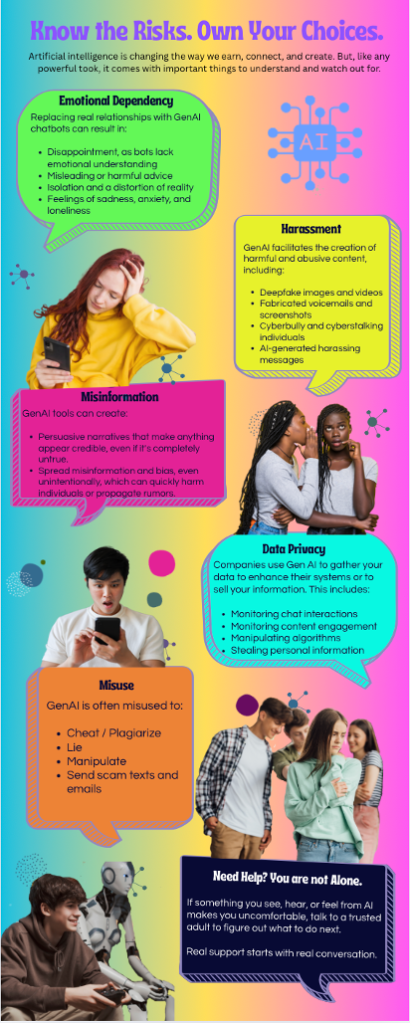
My research design involved several interrelated components. I began by articulating specific research questions, which guided the discussion prompts and discussion. To complete these discussions, we reviewed two separate campaign pieces. I designed two pieces of collateral to foster discussion with the teens: an infographic and a video.
- How do teens describe their use of GenAI in their own words?
- What emotions emerge when viewing AI-related visuals or narratives such as the created infographic and video?
- What risks concern them with the use of GenAI?
- How do they perceive their friends’ use and the risks associated with Gen AI?
- How much do their parents pay attention to their use of Gen AI? (I also had a separate survey that the teens’ parents could optionally fill out, which discussed their knowledge and discussions about their teens’ GenAI use.)
Process and Research Tools
After creating a formal research plan and consent protocol, I ensured ethical compliance and participant confidentiality. The parents and teens were ensured transparency, voluntary participation, and data privacy.
- Preliminary Scan and Secondary Research
Before designing the focus groups, I reviewed existing literature and AI campaign case studies. This helped us establish baseline expectations around audience use, expectations, concerns, and patterns of GenAI Use. - Instrument Design
I developed a semi-structured discussion guide featuring open-ended questions that were designed to learn about their current use and thoughts of GenAI. - Data Collection
During dinner, we held two sessions, which were recorded and transcribed for analysis. Participants reacted to campaign materials, discussed associations with AI, and reflected on the social and ethical implications of emerging technology. - Analysis and Coding
Using the transcripts I identified patterns across participant responses, allowing insights to surface.
Findings and Observations
Several key insights emerged from our focus group discussions. The teens did not react well to presentations that appeared similar to the mental health campaign posters around their school. They also did not want to receive warnings on potential misuse of GenAI. They wanted real solutions. Their parents were typically unaware of their GenAI usage. They did have concerns with GenAI and environmental impact. They were less concerned about protecting their private data. Although general insights were gathered, the teens often contradicted themselves.
Challenges and Lessons Learned
As the actor/comedian W.C. Fields once said, “Never work with children or dogs.” While the process was rewarding, it was not without challenges.
Finding 12 teens who were willing to discuss GenAI and who reflected diverse perspectives required time and outreach. I learned the importance of oversampling and building in flexibility for scheduling and demographic balance. Being in the industry, I continually needed to check what I know to be true and the assumptions I made about my audience to minimize influence on participant responses. Transforming data into actionable recommendations required more rigor than expected, as the responses of the teens were very contradictory.
Despite these challenges, the experience reinforced the value of qualitative methods in communication research that purely data-driven approaches often overlook.
The Value of the Focus Group in Campaign Development
Conducting the focus group fundamentally shaped my AI campaign. It allowed me to design messaging that was not only informative but resonated with the teens. By incorporating audience feedback, I improved message clarity, tone, and resonance.
From an academic standpoint, the project demonstrated the practical intersection of theory, research, and application. It validated that strategic communication benefits most when guided by evidence-based insight rather than assumptions.
Reflection and Future Implications
In reflecting on this experience, I learned that the act of listening is central to effective communication design. Focus groups create a space where real people’s perspectives shape creative strategy, reminding us that communication is ultimately a dialogue, not a broadcast. The integration of audience-centered research not only strengthens outcomes but also ensures that technology communication remains transparent, inclusive, and trustworthy.
 Strategic Storytelling